

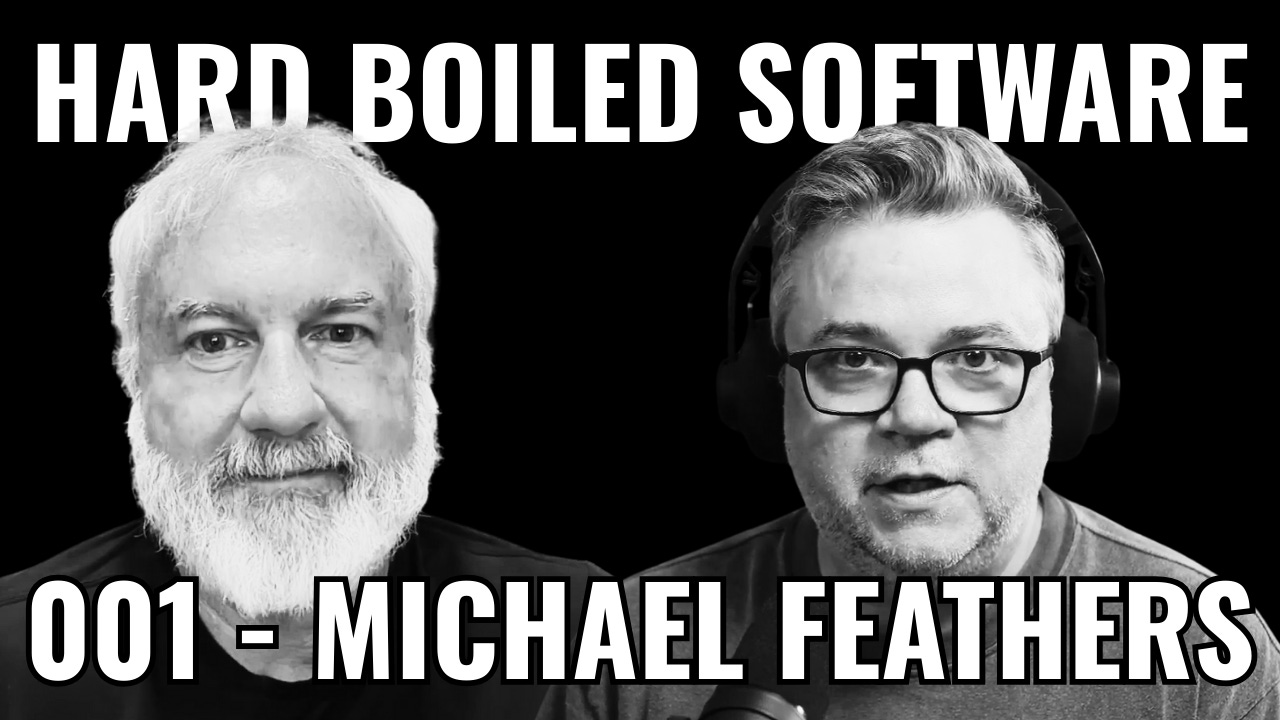
Michael Feathers is the author of Working Effectively with Legacy Code, the de facto survival guide for developers dealing with gnarly, untested systems for nearly two decades. He’s been a thought leader in software craftsmanship, refactoring, and technical excellence throughout his career.
Working Effectively with Legacy Code — Michael’s seminal book on wrangling tougher codebases
R7K Research & Conveyance — Michael’s company specializes in software and organizational design
Michael’s LinkedIn Profile — Follow for Michael’s current events and thinking
Episode Summary
Dave and Michael have an honest conversation about what’s happening to the software profession right now. From the dopamine hit of programming to the commoditization of hard-won skills, they explore professional identity, second-order effects of AI adoption, and what remains evergreen in a rapidly shifting landscape.
Topics Covered
Where has all the dopamine gone?
Programming’s intrinsic reward loop—the rush of solving problems and getting closure through code
Whether AI usage can replicate that satisfaction
The difference between the TDD flow state and the AI-assisted workflow
Availability Bias & Path Dependency
Michael’s biggest AI concern: accepting the first generated solution without considering alternatives
Software’s deep path dependency—early decisions compound
The Starbucks analogy: do you care about coffee or caffeine? Design or delivery?
Navigating Programmer Ego Death
The psychological transition as coding skills get commoditized
Reframe: loving programming means loving understanding and building systems—social, organizational, economic
Evolution from “problem solvers” to “problem articulators”
Second-Order Effects of AI in Organizations
Junior dev displacement may be overstated
Dan Shipper’s model: pairing senior/junior developers with separate agents plus shared AI ops support
The real risk: generating code you don’t understand at unprecedented speed
Metrics creep—lines of code (or token usage) returning; Goodhart’s Law incoming
What Skills Remain Evergreen
Examples over specifications—few-shot prompting works; Brian Marick’s “an example would be handy right about now”
Sidestepping problems—knowing when to abandon a dead-end approach
Value judgments in architecture—AI can’t implicitly understand context-specific values
Learning how to learn—meta-learning strategies matter more than any specific technology
The Architecture Moat
No “GitHub for architecture”—no standardized documentation unit
Design and architecture remain more human-protected domains
Experiment: asking an LLM “how would Michael Nygaard design this system?”


