
Rethinking Learning Design with AI
The training workshop finally gets tools.

Our training at Nerd/Noir already works. Our immersive/experiential style gets people straight into the problem with minimal theory.
But there’s always room to grow. Even carefully designed exercises can feel generic when they don’t map to the specific people in the room or the pains they’re directly experiencing. Customization works, but it takes time and money. Tailoring scenarios to a specific industry or context could mean weeks of prep for a one-time engagement. Not feasible.
AI just blew past that ceiling. It makes it absurdly easy to build small, interactive tools that let people FAFO with ideas directly. Not slides about a concept, but a hands-on experience with the concept — tailored to a specific room’s needs, pains, industry, concerns, et. al.
Example: A Cumulative Flow Scenario Explorer
One of our go-to teaching tools is the Cumulative Flow Diagram. CFDs show you where inventory piles up and bottlenecks form in a flow of work. They’re powerful, but they can be abstract when you’re staring at a static image on a slide.
Recognizing this lameness, we built an interactive CFD scenario explorer: tools.nerdnoir.com/cumulative-flow-diagram.
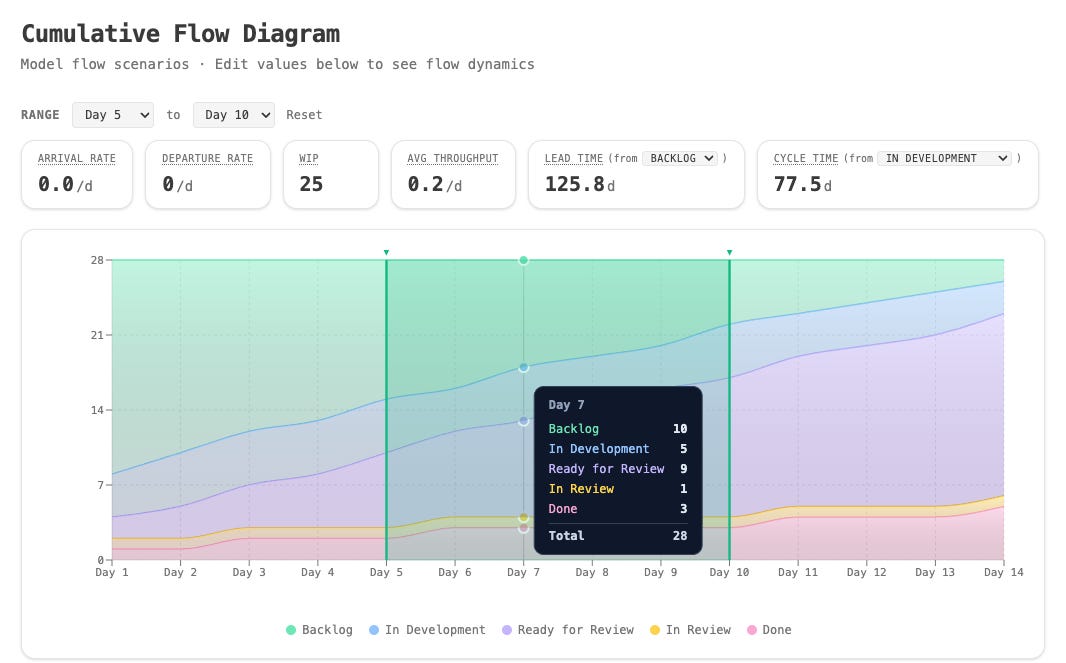
Load different scenarios. Watch how bottlenecks form in real time. Create your own scenarios and see what happens. As we like to say, visuals are valuable.
It’s a playground for a concept that once lived in a lecture on a static image.
Before You Say It
I can hear an objection forming: “CFDs? Really, dude? AI agent fleets are about to crush the coding bottleneck. Do we still need to understand flow?”
The handoff-driven software engineering model is being eaten by AI. But bottlenecks shift. They don’t vanish. Understanding where inventory accumulates in your system is a first principle. That doesn’t change just because the constraint moves.
No matter how AI-augmented your shop is, value must still flow through discovery, design, validation, and delivery. This is especially true in enterprise contexts where the stakes are higher and the feedback loops are longer.
The CFD isn’t going anywhere; the bottleneck it reveals just moves upstream. So, I suggest you learn the fundamentals, but I’m betting I can help your group do that faster and more effectively.
This Is Cheap Now
This didn’t take us three months to build. It took a week.
I wouldn’t call this vibe-coded. It’s more of an agentic workflow with a human (me) all up in the loop. We’re developing more fluency and opinions on tools like Claude Code, our rig is improving, and we’ll have more to say on that soon. But it’s uncomfortable in a good way. My tried-and-true instincts keep bumping into this new architecture, and some survive, while others don’t. But the dopamine hits from learning sure are awesome.
How we built the tool isn’t the point. What matters is what you can do once building gets this cheap.
The speed matters, but the leverage comes from accelerated customization. We can develop scenarios that map to a specific industry or problem space, so people will see themselves in it. There’s a big difference between “here’s a generic example of a bottleneck” and “here’s your bottleneck, modeled from your patterns we’ve seen in your kind of work.” One gets a polite nod. The other stokes a conversation.
More to Come
We’re building more of these tools at Nerd/Noir. A broader knowledge site that compounds on these ideas is in the works. It’s not ready for wide release quite yet; I’m just teasing our new direction here.
For now, go play with the CFD explorer at tools.nerdnoir.com/cumulative-flow-diagram. Create and break some scenarios. Model your bottlenecks. Copy the markdown into the LLM of your choice and learn some more.
And let us know what you think!
/ Dave
P.S. The tools site has no tracking, no server-side storage, local only. We’re not trying to become a SaaS company, certainly not in today’s economy. We’re just in it for the learning!